
Output is not what separates a single-layer, AB, ABA or ABC three-layer blown film machine. Our single-layer lines reach 280 kg/hr, our two-layer lines reach 250 kg/hr, and every structure in our range tops out at 140 kg/hr or more.
What the structure does decide is how many different materials your film can contain, and where each one sits. Choose on output alone and you can end up paying for three extruders to make a film that only ever needed two materials. Or you end up with a single extruder and no way to keep lower-cost resin off the film surface.
That is why it pays to write down what your film has to contain before you settle on a tonnage. The material list narrows the choice faster than any output figure.
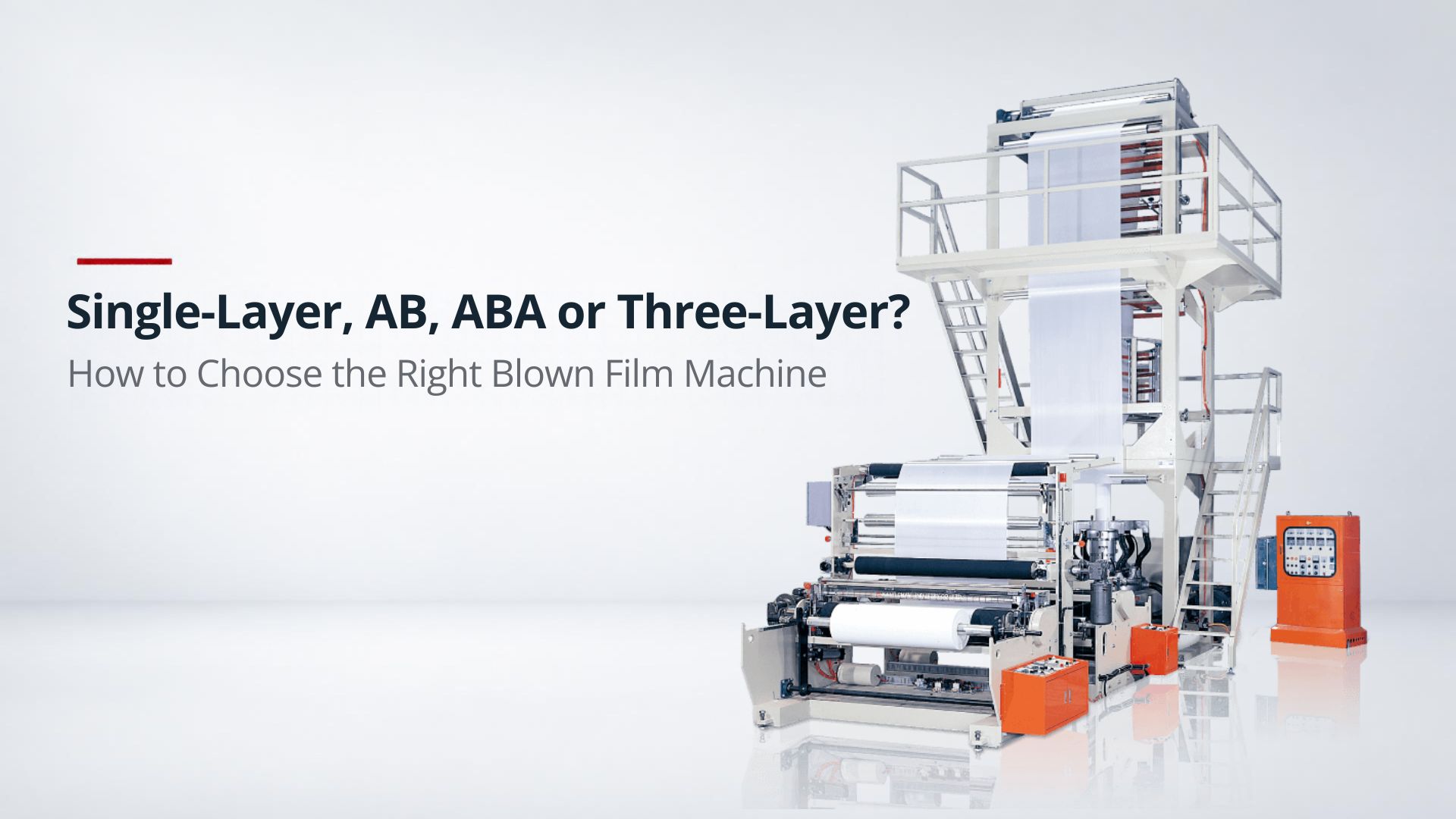
Blown film machines come in four basic structures: single-layer, AB two-layer, ABA and ABC three-layer co-extrusion. In these names each letter is a layer, and a repeated letter means the same material from the same extruder. Two numbers set the structures apart: how many extruders feed the die, and how many layers the die forms from that melt.
The die is what sets the layer count. Two extruders feeding an AB die make a two-layer film, and the same two extruders feeding an A/B/A die make a three-layer film. This table compares the four structures across our range, including the polyethylene grades each one is rated for: high-density (HDPE), low-density (LDPE), linear low-density (LLDPE) and metallocene (mLDPE).
| Single-layer | AB two-layer | ABA | ABC three-layer | |
|---|---|---|---|---|
| Extruders | 1 | 2 | 2 | 3 |
| Layers in the film | 1 | 2 | 3 | 3 |
| Different materials | 1 | 2 | 2 | 3 |
| Our models | KMT-45/55, KMT-65, KML-120 | KMTL-40/45, KMTL-55, KMTL-65 | KMTL-50S, KMTL-4545T (twin-head) | KMTL-E3 |
| Output | 10–280 kg/hr | 15–250 kg/hr | 10–32 kg/hr per head to 90–140 kg/hr | 110–250 kg/hr |
| Maximum film width | 3,000 mm | 2,000 mm | 1,200 mm (400 mm × 2 on twin-head) | 1,800 mm |
| Rated materials | HDPE, LDPE, LLDPE | HDPE, LDPE, LLDPE | HDPE, LDPE, LLDPE | HDPE, LDPE, LLDPE, mLDPE |
The output and width rows bear out the point made at the top: the four structures overlap heavily on throughput. The rows that differ cleanly are extruders and materials.
Screw length does not separate the structures either. Every line in our range starts from a 26:1 length-to-diameter (L/D) ratio, whatever its size or structure, and we adjust the screw to the resin you plan to run. For recycled material, we generally recommend around 28:1 to 30:1. The sections below take each structure in turn.
A single-layer blown film machine is the right choice whenever one material does the job, and it is not limited to low-output work. Our range runs from the KMT-45/55 at 10 to 72 kg/hr, through the KMT-65 at 30 to 105 kg/hr, up to the KML-120 at 280 kg/hr on film 1,800 to 3,000 mm wide.
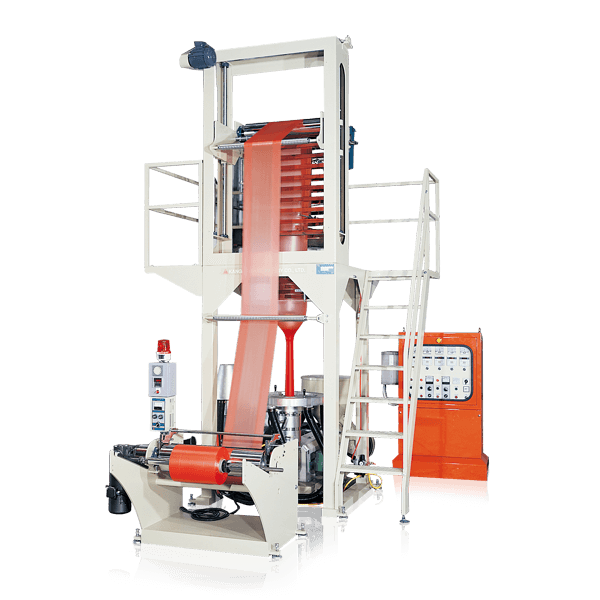
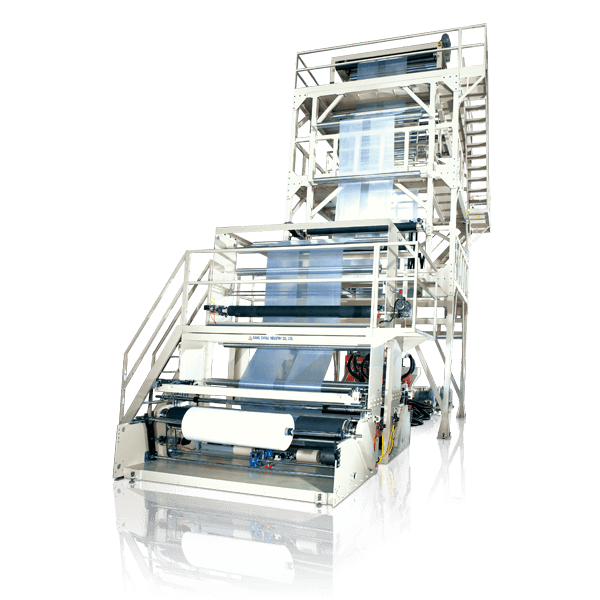
The KMT-45/55 shows what a typical single-layer line in our range looks like. Its main specifications are:
One extruder feeding one die is also the simplest system to run and maintain. When a second material has to go into the film, whether a different resin, a second color or a cheaper grade, you need a second extruder.
A second extruder gives you somewhere to put a second material. An AB die stacks the two melt streams into two layers, one from each extruder, so the two layers can differ in resin, color or cost.
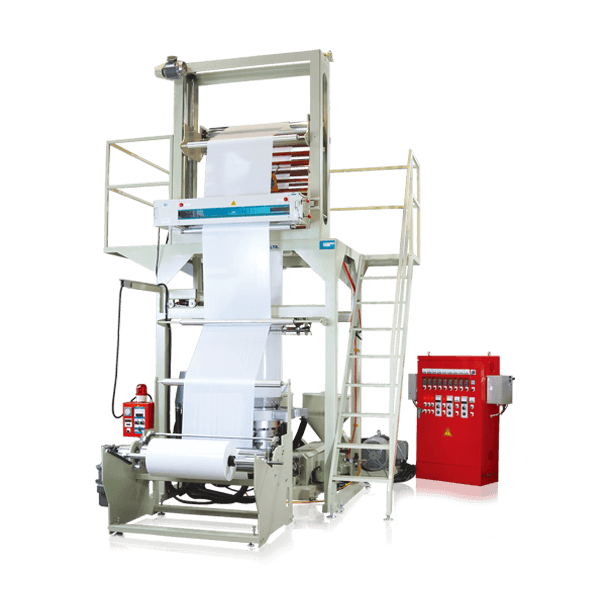
Our two-layer family covers almost the whole output range of our single-layer machines:
Color is a structure decision too. The KMTC-40/45 two-color line runs two Ø40 mm or Ø45 mm HDPE screws into a 24-line die at 85 m/min, producing two-color, two-layer film at 15 to 50 kg/hr. If your product stands out by how it looks rather than how it performs, that is the line to compare against a wider one.
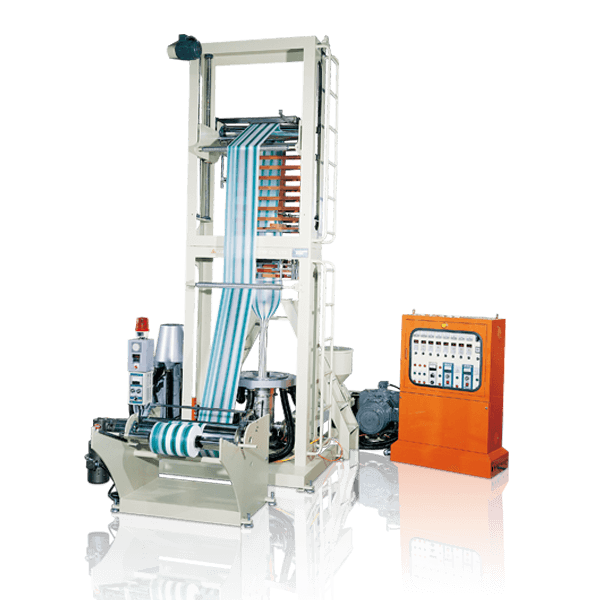
An AB film puts each material on its own face. When you want a cheaper material buried inside the film, with the same material on both surfaces, the structure you need is ABA.
An ABA blown film machine makes a three-layer film from two extruders. The A/B/A die splits one extruder's melt between both outer layers and places the second extruder's melt between them. The two skins carry the appearance, sealing and print surface, and the core can carry a lower-cost material such as filler or recycled resin without reaching either face.
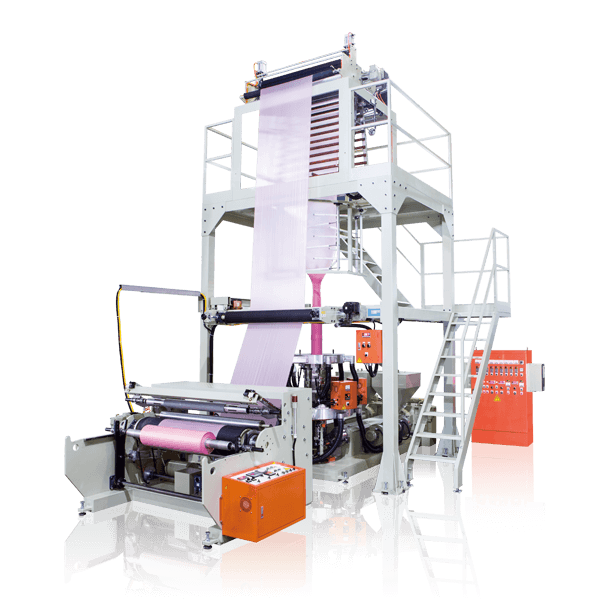
Our KMTL-50S is built around this structure. Its main specifications are:
An ABA line delivers a skin-core-skin film without a third extruder to buy, power, cool and control. That is the whole cost case for the structure.
The trade-off is that both skins have to be the same material, because they come from the same extruder. If your film can live with that, ABA gives you the three-layer construction with one extruder fewer than ABC. If the two faces need different properties, read on to the ABC section.
The KMTL-4545T runs the same ABA structure through two die heads instead of one. Its rated output of 10 to 32 kg/hr and film width of 400 mm both apply per head, so the machine produces two independent 400 mm webs at once rather than one 800 mm web. It has two Ø45 mm screws and a take-up speed of 85 m/min.
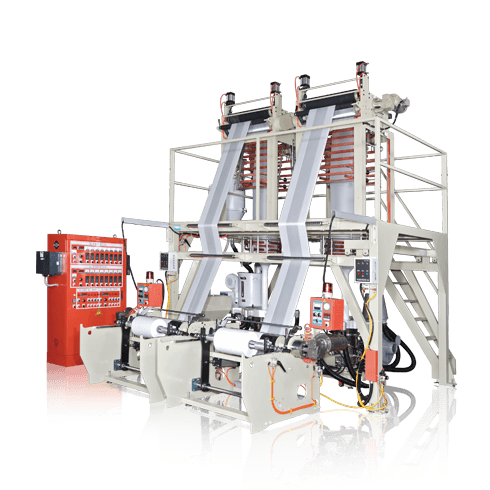
The choice between the two ABA machines comes down to the web you need: one web up to 1,200 mm wide on the KMTL-50S, or two separate webs up to 400 mm each on the KMTL-4545T. The same twin-head layout exists without co-extrusion on our KMH-45T, which feeds two Ø45 mm HDPE screws into two die heads at 24 kg/hr each.
Both ABA machines share one limit: the two skins are always the same material. When that limit stops working for your film, a third extruder becomes necessary.
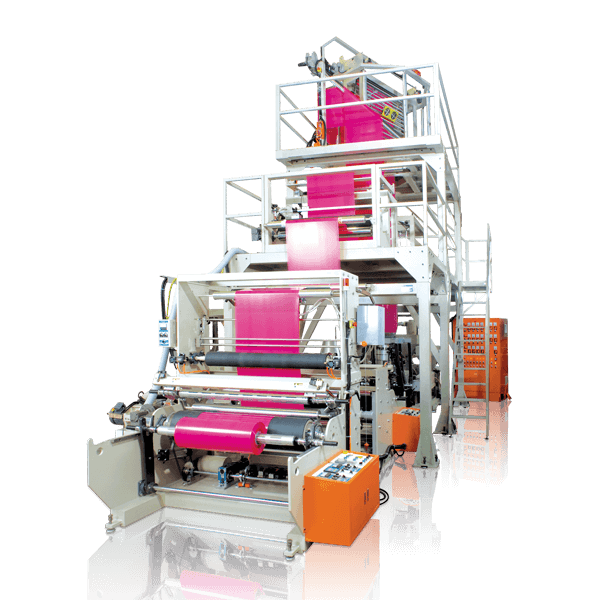
An ABC three-layer blown film machine gives each layer its own extruder, so all three layers can be different materials. That is the one thing a third extruder adds that ABA cannot. Our KMTL-E3 three-layer line comes in three builds:
| Model | Screw diameters | Film width | Output |
|---|---|---|---|
| KMTL-40-45-40 E3 | Ø40-45-40 mm | 900 mm | 110 kg/hr |
| KMTL-45-55-45 E3 | Ø45-55-45 mm | 1,400 mm | 150 kg/hr |
| KMTL-55-65-55 E3 | Ø55-65-55 mm | 1,800 mm | 250 kg/hr |
With a separate extruder on every layer, the core can be given over entirely to recycled material. On our three-layer lines we can run 100% recycled material in the B layer and 100% new material in the A and C layers.
The A and C proportions can be adjusted during production, and raising the B layer's share still keeps output quality high, as we described in New Generation, New Prospect in Plastic Converting Industry. This avoids the quality problems that come from blending a high share of recycled resin through a single melt stream.
The KMTL-E3 is also the only line in our range rated for mLDPE. It carries the longest optional-equipment list in our blown film range, with ten items. These include an oscillating haul-off with 270° rotation, a continuously rotating 360° die, edge position control (EPC), film tension control, and a programmable logic controller (PLC) with servo-driven operation.
Whichever structure the material list points to, the model within that structure still depends on a handful of measurements.
Choosing a blown film machine comes down to five inputs. The first one matters most, because it decides the structure, and it is the easiest one to leave until last:

Two long-standing customers show how those inputs play out once the machines are running.
Both of the customers below run our KMTL two-layer machines, and both have kept buying from us for well over a decade.
A disposable plastic bag plant in Changhua, Taiwan, serving its home market, came to us with two clear needs: high output and as few operators as possible. We recommended the KMTL series, configured as a low-density two-layer line producing 80 kg/hr. We added load warning and power-saving devices, which also gave the plant the energy savings it was looking for.
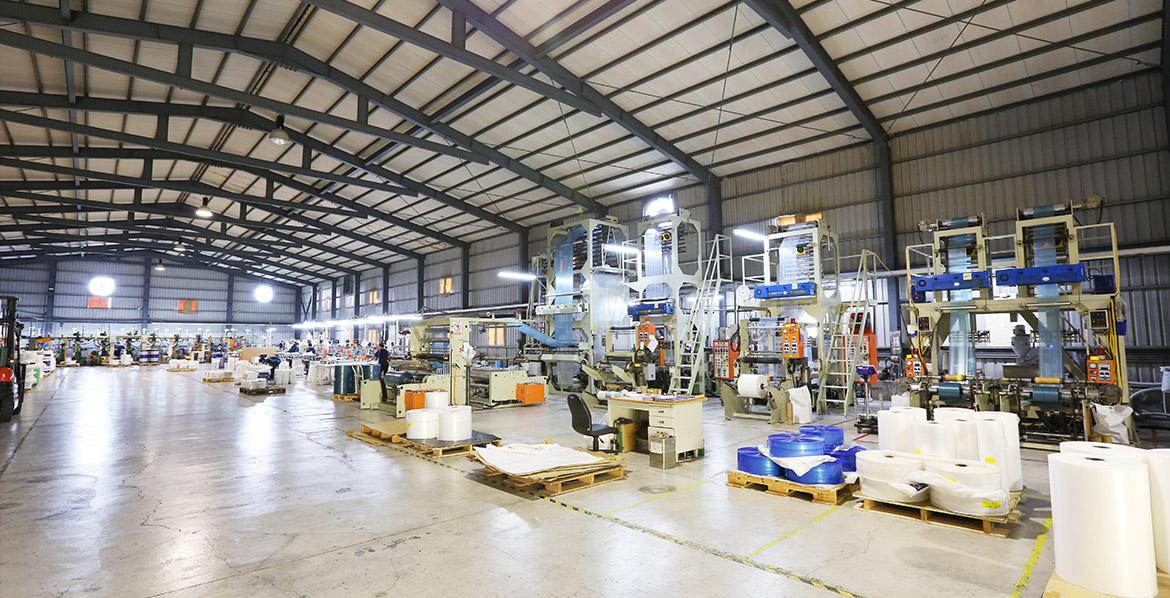
The relationship has now run for more than 15 years. As the business has grown, the plant has kept adding new machines, and we have serviced the lines throughout. Read the full case.
A South African maker of express delivery bags and shopping bags, already a major player in its local market, has worked with us for more than 20 years. The second generation now runs the company and is still expanding. Its plant of almost 20,000 m² runs ten of our large machines alongside two of our plastic recycling machines.
The KMTL two-layer high-speed line we showed at Taipei PLAS 2018 is the model this customer bought. Read the full case. Plants that want to process their own film scrap on site can pair a film line with a waste film recycling and pelletizing line.
Neither customer started from a layer count. Each started from its own production goal and chose the structure that met it, which is the order this guide recommends.
A few questions come up when comparing quotations that the sections above do not cover.
An ABA machine uses two extruders to make a three-layer film, so either label can appear on a quotation. To compare offers on equal terms, check the number of extruders and whether the die is an A/B/A design, rather than relying on the layer count in the machine name.
No. Take-up speed depends on the model, not the layer count. In our range, the ABA KMTL-50S is the fastest at 100 m/min, while the three KMTL-E3 builds run at 65, 45 and 40 m/min.
Yes. Our single-layer KMT-55CE is engineered to run a blend of 67% virgin LDPE and 33% recycled material. At that ratio the film keeps the tensile strength, puncture resistance and optical clarity expected from a virgin run. For a higher recycled share, our ABC three-layer lines can give the entire core layer over to recycled material, as described above.
Yes. Along with HDPE, LDPE and LLDPE, our machines work with biodegradable materials including polylactic acid (PLA), polybutylene adipate terephthalate (PBAT) and polyvinyl alcohol (PVA). One California customer has run only PLA on our machines for more than a decade. Its first line made film only 50 cm wide at about half the output of polyethylene. The current PLA line now makes 1 m wide film, with better output than before.
The structure follows from your material list, and the right model follows from the other four measurements. Send us the five specifications above and our engineers will tell you which structure they point to and which model fits.
Use our contact form and put these details in the Comments box:
If you already run one of our machines and are planning an upgrade or an additional line, add your current model number so our engineers can start from the line you have today.
To see these structures in production, read how a Changhua bag plant runs our KMTL series at 80 kg/hr, and how a South African express bag producer added new machines to grow its local market share. Our full blown film extrusion machine range lists every model in this guide.
