
Blown film extrusion is the process of melting polyethylene or polypropylene pellets, forcing the melt through a ring-shaped die, and inflating it into a bubble that is cooled, flattened and wound into a roll of film. It runs as seven linked stages, and nearly every film defect a converter sees can be traced back to one of them. Knowing which stage controls thickness, strength and flatness lets you read a machine's specification sheet line by line and ask a supplier the questions that matter for your film.
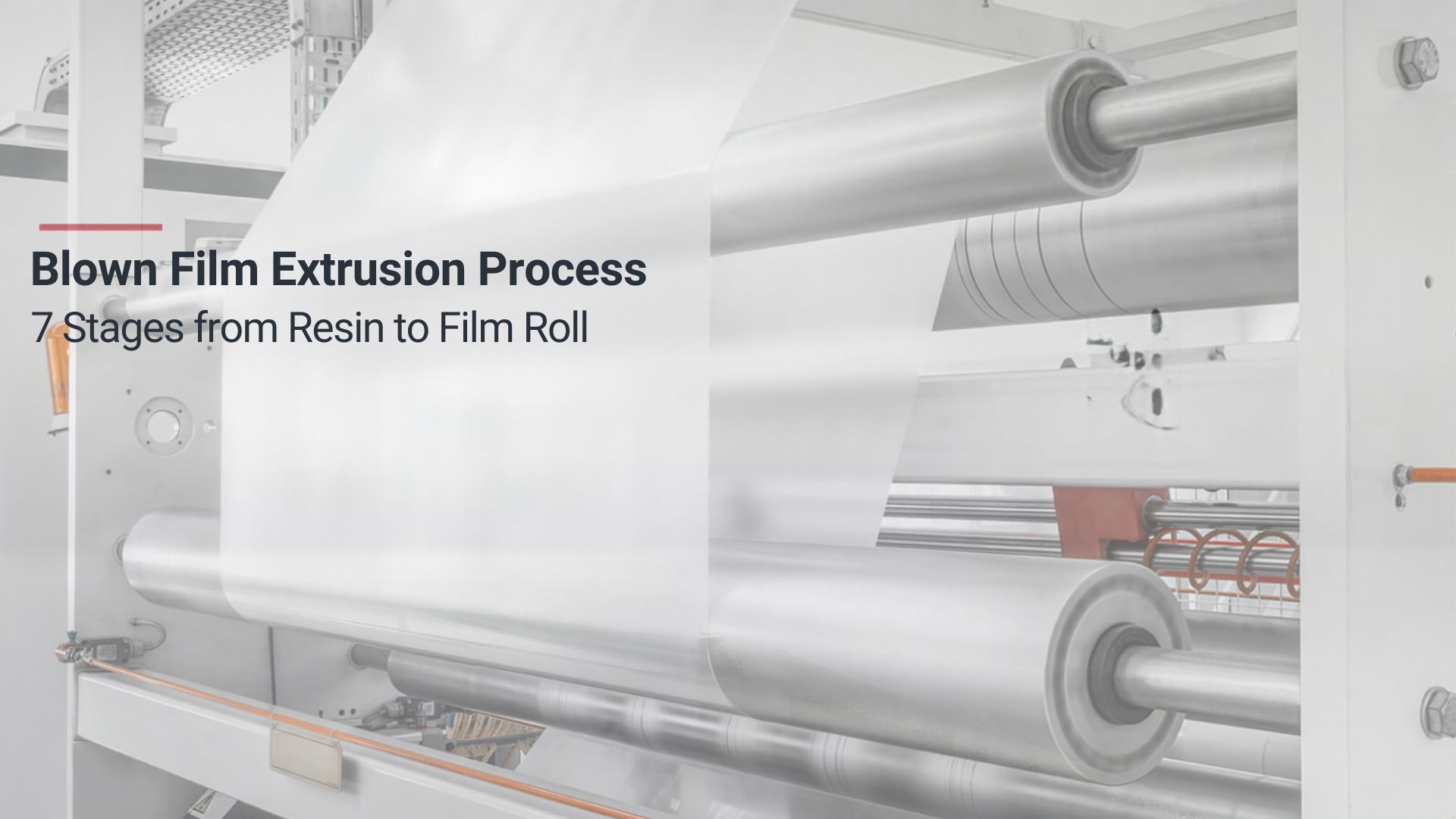
Blown film extrusion is a method of making plastic film in which molten resin is pushed through a circular die to form a thin-walled tube, then expanded with internal air into a bubble before it is cooled and flattened. Because the tube is stretched along its length and around its circumference at the same time, blown film is oriented in two directions, which gives it balanced toughness for bags and wraps.
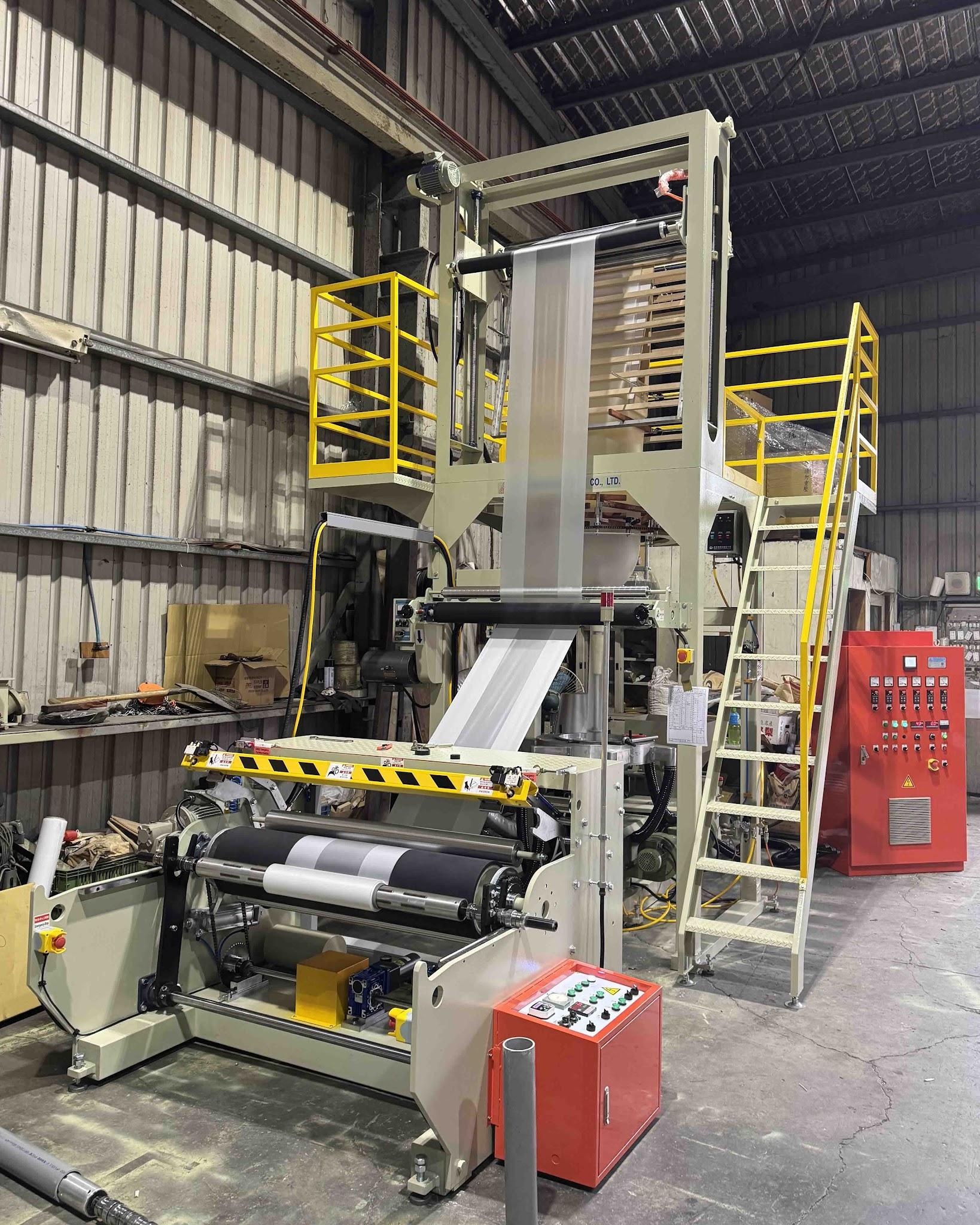
Polyethylene in three grades does most of the work. High-density polyethylene (HDPE) makes thin, crisp film for T-shirt bags; low-density polyethylene (LDPE) gives softer, clearer film; and linear low-density polyethylene (LLDPE) adds puncture resistance and stretch. Our blown film machines are grouped by these resins, with a separate series for polypropylene (PP), and our KMTL-E3 three-layer line also runs metallocene polyethylene, listed as mLDPE on its spec sheet.
The finished film becomes shopping and T-shirt bags, courier bags, food packaging, garment bags, stretch film and agricultural film.
A blown film line turns resin pellets into a roll of film in seven stages: melting, shaping, inflation, cooling, collapsing, haul-off and winding. Inflation and cooling happen together as the bubble rises, and the film's thickness and structure are frozen at the frost line. The haul-off speed in stage 6 decides what that thickness is, while stages 5 and 7 flatten the film and prepare it for printing and converting.
The extruder melts resin pellets and delivers a steady, uniform stream of melt to the die, and every later stage depends on how even that stream is. Pellets drop from the hopper into a heated barrel, where a rotating screw conveys, compresses and melts them. Unmelted particles show up downstream as gels, and an unsteady melt flow shows up as thickness that varies along the roll.
Screw length is expressed as the length-to-diameter (L/D) ratio. It is set by the resin you plan to run, not by the size of the machine. Every line in our range starts from a 26:1 screw, and for recycled material we generally recommend a longer screw of around 28:1 to 30:1.
The blown film die turns the melt stream into a thin-walled tube, and how evenly it spreads melt around its circumference sets the film's thickness profile across the width. Melt enters the die, is distributed around a ring, and exits through a narrow annular opening called the die gap. A die that runs hotter or tighter on one side produces a tube that is thicker on one side, and that error carries through every later stage.
We size each die to the film width the line is built to make. The KMT-45/55 spec sheet lists two die sizes for the KMT-45, Ø70/90 mm and Ø150 mm, while the KMTL-E3 ranges from a Ø200 mm die on its smallest model to Ø500 mm on its largest. On the KMTL-E3, a rotating die is available as an option. It turns continuously through 360 degrees, so any thick spot is spread across the whole roll instead of building up in one lane.
Once the tube leaves the die gap, air takes over the shaping.
The blow-up ratio (BUR) is the final bubble diameter divided by the die diameter, and it controls how far blown film is stretched in the transverse direction (TD), across its width. Air enters through the center of the die and is trapped between the die and the nip rolls, inflating the tube into a bubble. Because the flattened tube's width is half the bubble's circumference, lay-flat width works out to about 1.57 × BUR × die diameter.
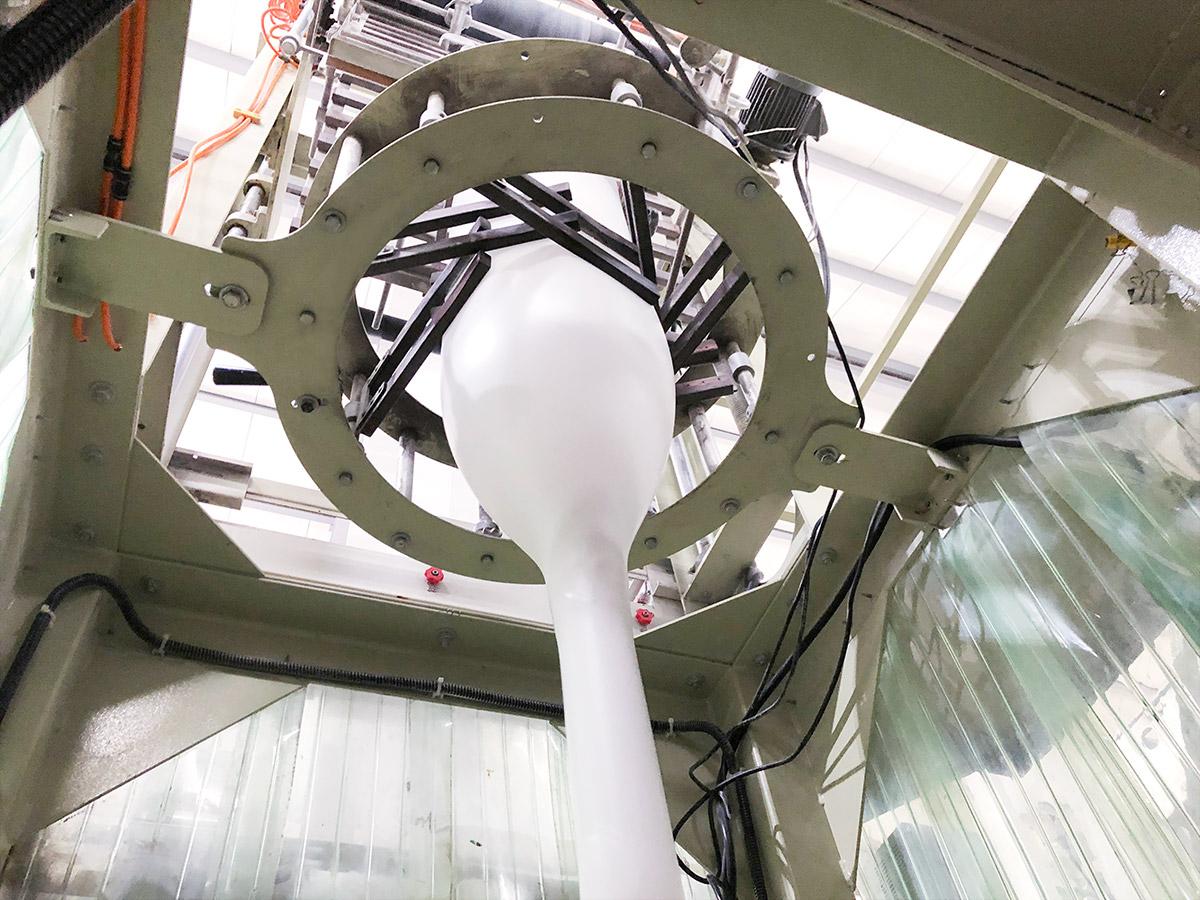
A higher BUR gives a wider film from the same die and more strength across the width. A lower BUR leaves more of the orientation in the machine direction (MD), along the film's length. BUR works as a pair with haul-off speed in stage 6, and the balance between the two decides whether the film tears more easily one way than the other.
The bubble stops growing once it is cool enough to solidify, and cooling is the job of stage 4.
The air ring blows a controlled stream of cooling air around the base of the bubble, and the frost line is the height at which the melt solidifies and the bubble stops expanding. It shows as a hazy band where clear melt turns into semi-crystalline film. Frost line height affects three things at once: clarity, the balance of strength between MD and TD, and output, because cooling capacity limits how fast a line can run.
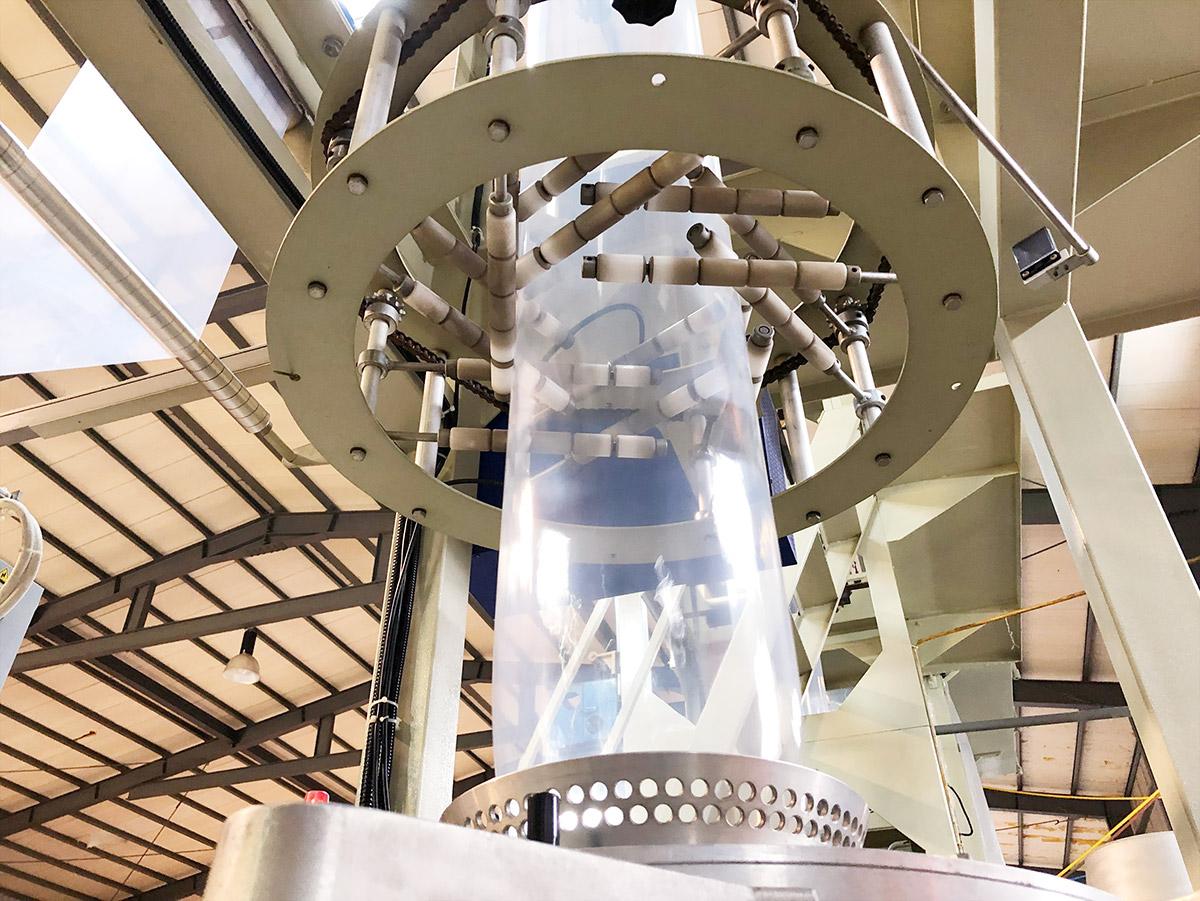
The air ring is sized to the die. On the KMT-45, the air ring diameter is Ø120 mm or Ø200 mm to match its two die sizes, and the cooling blower is rated at 3 horsepower (HP). The KMTL-E3 offers an optional air chiller and heat exchanger, which cool the air itself before it reaches the bubble.
The collapsing frame flattens the round bubble into a two-ply lay-flat tube, and the nip rolls at the top of the tower pinch it closed so the air inside stays trapped. The bubble's full circumference has to fold into a flat width with no slack. An off-center bubble or uneven cooling below shows up here as wrinkles and creases.
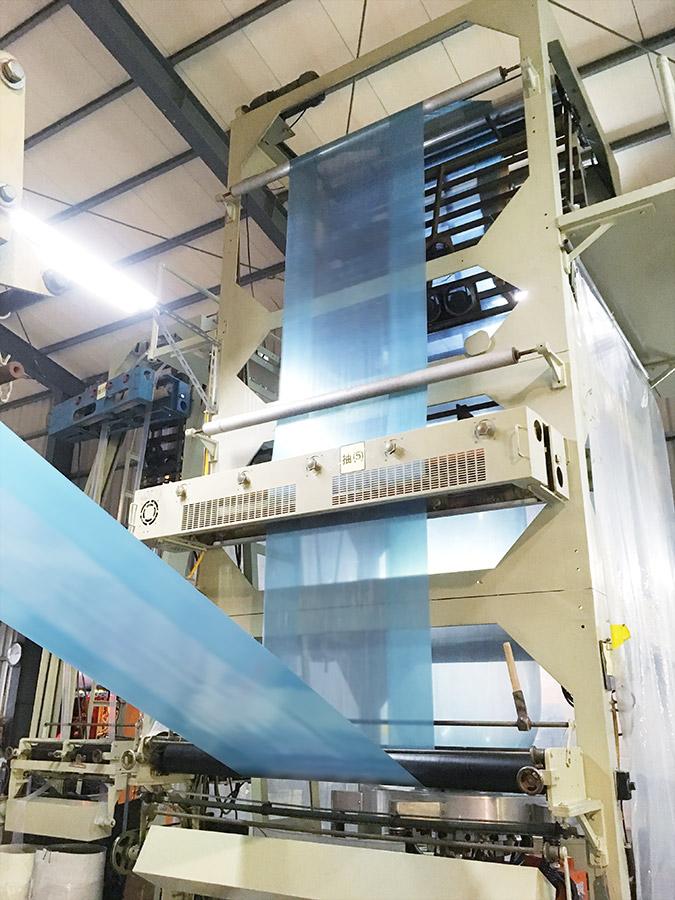
Haul-off speed, the speed at which the nip rolls pull film away from the die, sets blown film thickness and how far the film is stretched in the machine direction: at a constant output, pulling faster makes thinner film. The ratio between that speed and the speed of the melt leaving the die gap is the draw-down ratio, and together with BUR it decides the film's MD/TD strength balance.
Our spec sheets list the haul-off as the take-up unit. Take-up speed across our range runs from 22 m/min on the KML-120, which makes film up to 3,000 mm wide, to 100 m/min on the KMTL-50S. The KMT-45 is rated at 75 m/min and the KMT-55 at 65 m/min. On the KMTL-E3 three-layer line, an oscillating haul-off that rotates through 270 degrees is available; like the rotating die, it moves thickness variation around so that it does not stack up in one place on the roll.
The right haul-off speed depends on your resin, film width and target thickness. Send us those three figures through our contact form and we will tell you which take-up range fits your film.
A surface treater raises the surface energy of polyethylene film so that printing ink and adhesive bond to it, and it sits between the nip rolls and the winder. Edge position control (EPC) keeps the film aligned so the roll edges stay straight, and the winder turns the film into a roll at even tension.
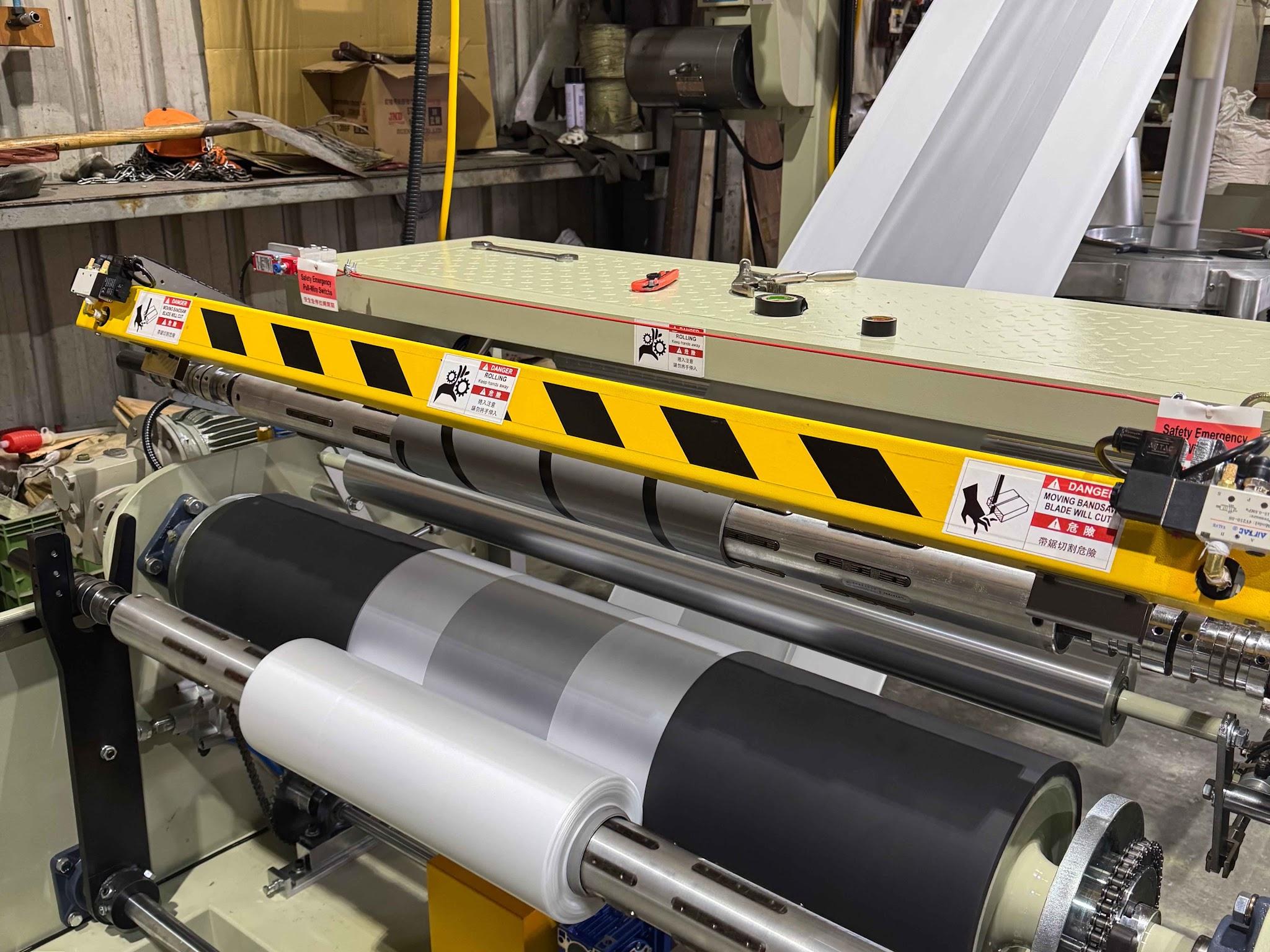
Each of our blown film machines comes with an electronic length counter and an accumulated time meter. On the KMTL-E3, a film surface treater, EPC, film tension control and a back-to-back winder are available as options.
Two film properties, thickness and strength, depend on more than one stage at once.
Blown film thickness is set by three variables together: extruder output, blow-up ratio and haul-off speed. Raise output and the film gets thicker. Raise BUR or haul-off speed and it gets thinner, because the same amount of melt is spread over a larger area. Air pressure inside the bubble affects thickness through BUR: more air makes a larger bubble, and a larger bubble spreads the same melt thinner.
Strength comes from orientation. Haul-off stretches the film along its length, BUR stretches it across its width, and a film stretched much more in one direction than the other tears easily along that direction. Bag and wrap film needs the two in balance, which is why BUR and haul-off speed are set as a pair rather than one at a time. Thickness uniformity across the width is a separate question, decided mainly by the die and the air ring.
Thickness consistency is also a key difference between older and current lines, as we set out in our comparison of traditional and high-speed inflation machines.
A multi-layer blown film line usually uses one extruder per layer and combines the melt streams inside the die, so a single film can carry different resins on the outside and in the core. Single-layer lines such as the KMT-45/55 run one resin or one blend. Our KMTL-E3 three-layer line uses three extruders, in screw configurations from 40-45-40 mm to 55-65-55 mm, and makes film up to 1,800 mm wide at up to 250 kg/hr.
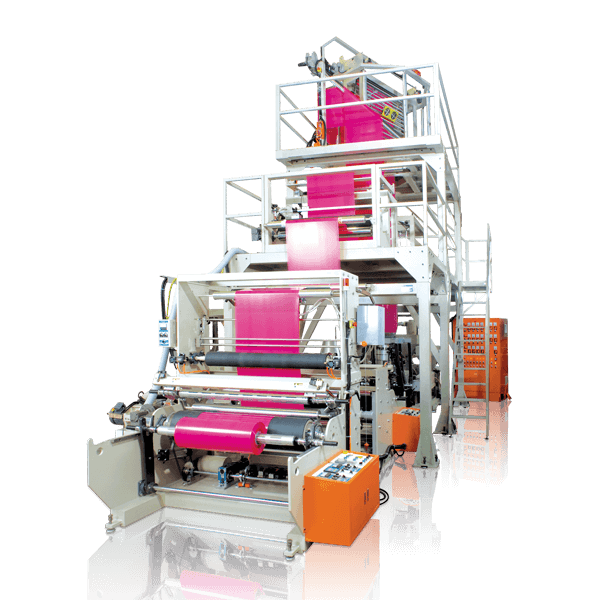
Co-extrusion lets a converter combine a sealing layer, a strength layer and a print layer in one film, or put recycled resin in the core between two layers of virgin resin.
Single-layer or multi-layer, every line above blows its film. The main alternative process makes film flat.
Cast film lines extrude melt through a flat slot die onto a chilled roll, while blown film lines extrude it through a ring die and cool it with air as a bubble. Because blown film is stretched in two directions, it has more balanced strength and toughness, which suits bags, liners and heavy-duty packaging. Cast film cools faster and more evenly on the roll, so it offers better clarity and tighter thickness control and runs at higher line speeds.
A blown film line also makes tubular film directly, which saves a sealing step when the end product is a bag.
The same seven stages are also the fastest route to the cause of a film defect.
Most blown film defects start at one identifiable stage of the line, and knowing which stage to check first narrows the search before any setting is changed. The table below pairs common symptoms with the stage where they usually begin:
| Symptom | Where to look first | Usual reason |
|---|---|---|
| Gels and unmelted specks | Stage 1: extruder | Incomplete melting or contamination in the melt |
| Thick and thin bands around the film | Stages 2 and 4: die and air ring | Uneven melt distribution or uneven cooling air |
| Bubble that sways or pulses | Stage 4: cooling | Unstable cooling air or frost line height |
| Film that tears easily in one direction | Stages 3 and 6: inflation and haul-off | BUR and haul-off speed out of balance |
| Wrinkles and creases | Stage 5: collapsing frame and nip rolls | Off-center bubble or uneven flattening |
| Poor print adhesion | Stage 7: surface treatment | Surface energy too low for the ink |
| Uneven or telescoping roll edges | Stage 7: winding | Edge misalignment or uneven winding tension |
A symptom can have more than one cause, so treat the table as the first place to look rather than a diagnosis.
Below are the most common questions about blown film extrusion.
Our KMH series HDPE lines make film as thin as 0.008 mm (8 microns), and the KMT-45 and the KML-45S/55S stretch film line reach the same minimum. The maximum thickness is 0.15 mm on most of our lines and 0.20 mm on the two larger KMTL-E3 models.
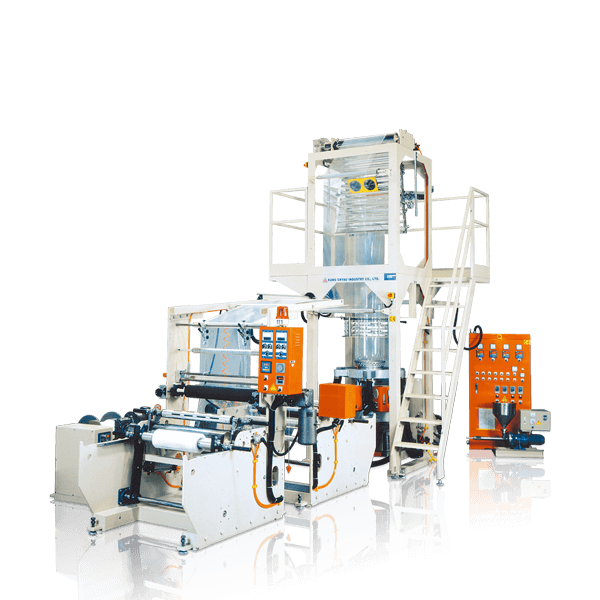
The KML-120 makes LDPE and LLDPE film from 1,800 to 3,000 mm wide, the widest in our range. The KML-80 and KMTL-65 reach 2,000 mm, and most of our other single-layer lines work between 100 and 1,400 mm.
Output across our range runs from 5–15 kg/hr on the compact KML-25 to 280 kg/hr on the KML-120. The KMT-45 produces 10–55 kg/hr across its two configurations, and the largest KMTL-E3 three-layer model reaches 250 kg/hr.
Thickness, strength and flatness each trace back to specific stages, and every one of those stages has a setting that depends on your film: the blow-up ratio, the frost line height, the haul-off speed. Those settings follow from four things we need to know first: your resin, film width, film thickness and output target. Write those four figures, plus the product you are making, in the Comments field of our contact form, and our engineers will recommend a line configuration and model.
